 by
by Basketball is played by two teams that try to score by throwing the ball through the opponent’s hoop. A team normally has five players on the court, and the team with more points at the end of the game wins. To start playing basketball, learn how to move legally with the ball, pass accurately, shoot under control, and defend without fouling.
What you need to understand first
A basketball court has a hoop at each end. One team attacks the hoop in its frontcourt while the other team defends it. After gaining possession, players move the ball by passing or dribbling. A player cannot run while holding the ball without dribbling; this is called travelling.
Games are divided into periods, although the exact length depends on the competition. School, community, and recreational games may use shorter periods than professional matches. Outdoor courts in Nigeria may also use local playing arrangements, but the main principles remain the same.
- Two points: A shot made from inside the three-point line.
- Three points: A shot made from beyond the three-point line.
- One point: A successful free throw after certain fouls.
- Possession: The team controlling the ball can attack and create a scoring chance.
The ball changes teams after a made basket, a missed shot recovered by the other team, a violation, or a defensive steal. Good basketball depends on quick decisions: pass when a teammate is open, shoot when space is available, and protect the ball when defenders apply pressure.
Basic basketball positions
Traditional basketball positions help players organise the attack and defence. Modern players often perform several roles, but these names are still useful for understanding how teams line up.
- Point guard: Usually brings the ball up, controls the offence, and creates opportunities for teammates.
- Shooting guard: Often looks for outside shots, drives to the basket, and defends opposing guards.
- Small forward: A versatile player who may shoot, drive, rebound, and defend several positions.
- Power forward: Plays near the basket, sets screens, rebounds, and scores from close or mid-range areas.
- Centre: Often protects the rim, contests shots, collects rebounds, and finishes near the hoop.
Beginners do not need to specialise immediately. Learning to handle the ball, pass, shoot, rebound, and defend makes it easier to contribute from any position.
Four skills every new player should practise
Dribbling
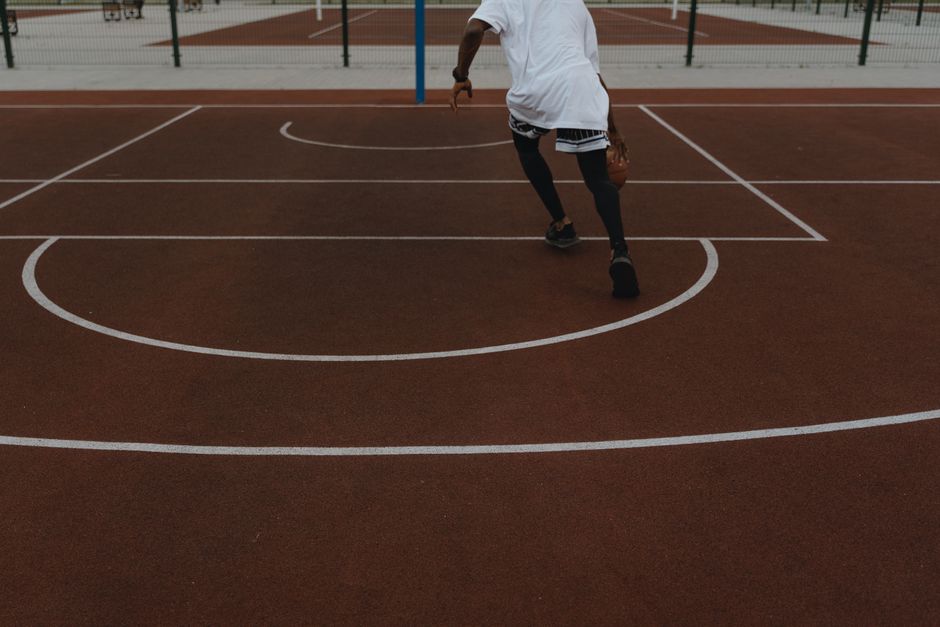
Use your fingertips rather than your palm to push the ball into the floor. Keep your knees bent, your chest up, and your eyes forward. Practise dribbling with both hands, changing speed, and protecting the ball with your body. A low dribble is harder for a defender to reach, while a controlled change of direction can create space.
Useful basketball dribbling drills include stationary right-hand and left-hand dribbles, crossover dribbles, and walking or jogging while switching hands. Avoid looking at the ball constantly because you need to see teammates, defenders, and open space.
Passing
The main passes are the chest pass, bounce pass, and overhead pass. Step toward your target and pass firmly to the teammate’s hands. A bounce pass should reach the floor roughly before the receiver so it arrives at a comfortable height. Do not pass blindly into crowded areas.
Shooting
For a basic basketball shooting technique, place your shooting hand under the ball and your other hand on the side for balance. Keep your feet stable, bend your knees, and extend your legs and shooting arm together. Finish with your wrist relaxed and your fingers pointing toward the hoop.
Start close to the basket and focus on a consistent release before moving farther away. Practise layups from both sides, free throws, and short jump shots. Accuracy and balance matter more than shooting from long range as soon as possible.
Defending and rebounding
Stay between your opponent and the hoop. Bend your knees, keep your feet active, and slide instead of crossing your legs. Keep your hands active without hitting or grabbing. A defender should watch the opponent’s chest rather than reacting only to the ball.
When a shot misses, find a player to block out, make contact legally, and then pursue the ball. Securing a defensive rebound ends the opponent’s attack; an offensive rebound gives your team another chance to score.
Important basketball rules for beginners
- Travelling: Moving with the ball without dribbling, or taking illegal steps after ending a dribble.
- Double dribble: Stopping a dribble and starting again, or dribbling with both hands at the same time.
- Carrying: Placing a hand underneath the ball while dribbling and turning it over.
- Out of bounds: The ball or the player holding it touches a boundary line or the area outside the court.
- Backcourt violation: A team that has established control in the frontcourt cannot usually return the ball to the backcourt and be the first to touch it.
- Personal foul: Illegal physical contact, such as holding, pushing, blocking improperly, or striking an opponent.
Rules can vary between FIBA, school, league, and recreational basketball. If you are joining a local game, ask about the court boundaries, game length, foul limit, and whether a made basket changes possession immediately.
A simple way to practise basketball
Begin each session with light movement and ball-handling. Then spend time on close-range shooting, layups, passing with a partner, and defensive footwork. Finish with a small-sided game such as two-on-two or three-on-three. Fewer players give everyone more touches and more chances to practise decisions.
- Dribble with each hand for several minutes.
- Make controlled passes while moving.
- Take close shots until your technique feels consistent.
- Practise layups from both sides of the hoop.
- Play defence using your feet and avoid unnecessary contact.
- Play a short game and focus on passing, spacing, and communication.
Wear suitable sports shoes, check that the court is safe, and warm up before playing. On an outdoor court, inspect the surface for loose gravel or wet patches. Beginners improve faster by playing regularly and reviewing one skill at a time rather than trying to fix everything in one session.
Common questions about playing basketball
Can I learn basketball without joining a team?
Yes. You can practise dribbling, shooting, passing against a wall, and footwork alone. Team games become valuable once you understand the basic movements because they teach spacing, communication, and decision-making.
What should a beginner learn first?
Start with the legal stance, basic dribbling, chest passing, layups, and defensive movement. These skills appear constantly in a real game and provide a stronger foundation than difficult trick shots.
How long does it take to learn basketball?
You can understand the basic rules in one session, but reliable ball control and shooting require regular practice. Playing two or three times a week can produce noticeable progress, especially when each session has a clear focus.