 by
by Good passing is more than throwing the ball to an open teammate. Players must see the floor, pass away from defenders, use the correct technique and move immediately after releasing the ball. These basketball passing drills develop those skills with limited equipment and work well in schools, clubs and community courts across Nigeria.
Passing fundamentals to practise first
Before increasing speed, focus on accuracy and timing. Keep both hands on the ball until the pass begins, step toward the target and finish with your fingers pointing in the direction of the pass. Players should pass to a teammate’s chest, outside hand or space in front of a moving teammate rather than simply throwing at the player.
- Chest pass: Use two hands to deliver a quick, direct pass to a teammate’s chest.
- Bounce pass: Aim for the floor about two-thirds of the distance to the receiver so the ball reaches waist height.
- Overhead pass: Use it to pass over pressure or reach a teammate farther away.
- One-hand push pass: Useful when a defender takes away the passing lane on one side.
- Pass fake: Move the eyes or ball first to make a defender shift before passing in another direction.
Receivers also have a job. Show a clear target, call the passer’s name, meet the ball when possible and secure it with two hands. After every pass, cut, screen or relocate instead of standing still.
Basketball passing drills for pairs
1. Stationary chest and bounce passes
Place two players three to five metres apart. Start with 20 chest passes, then complete 20 bounce passes. The receiver should catch the ball at chest or waist level without bringing the feet together. Increase the distance only when both players can pass accurately.
To make this a useful basketball passing exercise for beginners, require players to step toward every pass and call “ball” before receiving it. Add a pivot after the catch to practise protecting the ball.
2. Pass, pivot and protect
Players pass to a partner, close out under control and act as a passive defender. The receiver catches the ball, establishes a pivot foot, turns away from pressure and makes the next pass. Switch roles after each repetition.
Progress from a passive defender to a defender who reaches for the ball without fouling. This drill helps players learn how to handle a basketball double-team and avoid exposing the ball during a pivot.
3. Moving partner passes
Two players jog from one baseline to the other while completing chest passes. The player without the ball runs slightly ahead and shows a target. Repeat with bounce passes, then change the angle by having the receiver cut diagonally.
Do not reward speed if the pass is behind the runner. The passer should lead the teammate into open space, while the receiver should slow down or adjust the route when necessary.
Team passing drills for decision-making
4. Three-player weave
Three players begin at the baseline in separate lanes. The middle player passes to one side, runs behind that player and fills the opposite lane. The receiver passes across to the third player, then the group continues toward the other basket.
At first, keep the drill non-contact and emphasise passing ahead of the runner. Later, allow a defender to trail the play or require a layup after the final pass. The three-man weave improves passing on the move, spacing and communication.
5. Give-and-go passing drill
Place one passer on the wing, one player at the top of the key and a third player near the basket. The wing passes to the top, cuts hard toward the basket and receives a return pass for a layup. Rotate positions after each attempt.
Add a defender on the cutter once the timing is consistent. The passer should cut immediately after passing, and the return pass should arrive in front of the cutter rather than directly behind them.
6. Four-corner passing
Put one player at each corner of a square on the half court. Players pass around the square, follow their pass and fill the next position. Begin with chest passes, then add bounce passes and pass fakes.
For a stronger team passing drill, introduce a second ball after the group finds a steady rhythm. Players must communicate early and keep their eyes up before receiving the next pass.
7. Passing through pressure
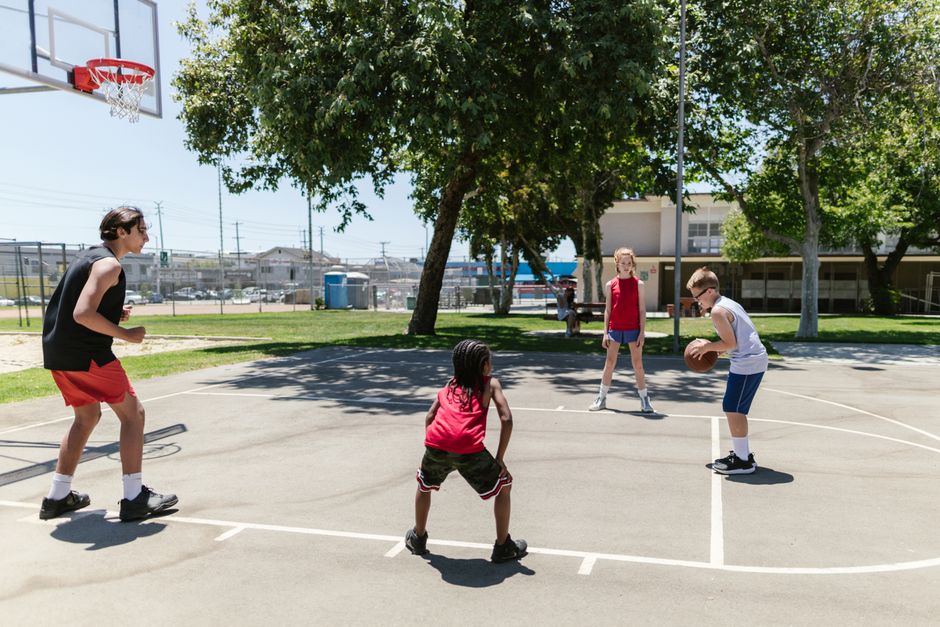
Divide players into groups of three: one passer, one receiver and one defender. The receiver cuts from one cone to another while the defender denies the passing lane. The passer has three seconds to deliver the ball.
Teach the receiver to change direction, show a hand target and create separation with a sharp cut. The passer should use a pass fake, pivot away from pressure and choose a safe passing window instead of forcing the ball.
Small-sided games that improve passing
8. Four-pass scoring game
Play three-on-three or four-on-four in the half court. A team must complete four passes before it can shoot. A pass that goes out of bounds, is intercepted or is thrown without a clear target resets the count.
This basketball passing game connects technique with real decisions. Players learn to maintain spacing, pass against defenders and recognise when a drive or shot is better than another pass. Remove the pass requirement once players begin making extra passes instead of taking open shots.
How to organise a productive passing session
- Use short rounds: Work for 30 to 60 seconds, then correct one clear mistake.
- Limit queues: Split a large group across several baskets or use stations with cones.
- Track quality: Count accurate passes, turnovers and successful catches rather than repetitions alone.
- Add pressure gradually: Begin without defenders, then introduce time limits, movement and live defence.
- Use available space: A school court, outdoor cement court or marked open area can support most of these drills.
For younger players, reduce the distance and use a lighter ball if available. For advanced players, demand weak-hand passes, one-touch decisions and passing after a hard closeout. Coaches should stop the drill when poor footwork or unsafe throws become repetitive rather than allowing speed to hide technical errors.
Common passing mistakes
- Passing from a flat stance: Players should bend the knees and step toward the target.
- Watching the intended receiver: Use the eyes to move the defender before delivering the pass.
- Throwing at stationary teammates: Pass to a hand or open space based on the teammate’s movement.
- Standing after the pass: Cut, screen or relocate to create another option.
- Forcing risky passes: Protect possession and reverse the ball when the lane is closed.
Frequently asked questions
What are the best basketball passing drills for beginners?
Start with stationary chest passes, bounce passes, pass-and-pivot work and moving partner passes. These exercises build accuracy, footwork and catching confidence before defenders are added.
How often should a team practise passing?
Include passing in every practice, even if the session is focused on shooting or defence. Ten to 15 minutes of focused passing work can improve technique, while small-sided games develop decision-making under pressure.
How can players improve passing with no equipment?
Use court lines, shoes or water bottles as movement markers. Players can practise partner passing, give-and-go actions and three-player movement with only a basketball and a safe playing surface.
Why do players make accurate passes in drills but lose the ball in games?
Unopposed drills do not reproduce defensive pressure. Add active defenders, time limits, changing passing lanes and small-sided games so players learn to read pressure and select safer options.