 by
by Athletics track dimensions vary by facility, but a standard outdoor track is designed so that one lap in lane one measures 400 metres. The most widely used competition layout has two straight sections, two semicircular bends and lanes that are each 1.22 metres wide.
What are the standard dimensions of an athletics track?
A standard 400-metre athletics track usually has the following measurements:
- Total lap distance: 400 metres in lane one
- Lane width: 1.22 metres, including the lane line
- Number of lanes: commonly eight, although nine-lane tracks also exist
- Straight length: about 84.39 metres between the curves on a typical competition track
- Curve radius: approximately 36.50 metres to the inside edge of the track
- Track surface: commonly synthetic, with the exact construction depending on the facility
The 400-metre distance is measured along the official measurement line in lane one, rather than directly beside the inside kerb. This distinction matters because a runner close to the inside edge would otherwise cover slightly less distance.
How wide is each athletics track lane?
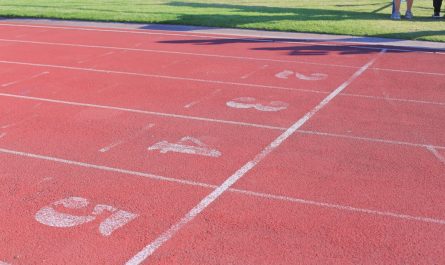
Most modern athletics track lanes are 1.22 metres wide. White lines separate the lanes, and the line is included in the lane measurement. Older tracks may have lanes close to 1.20 metres wide, but their markings and race measurements may not match current international specifications.
The inside of lane one normally has a kerb or clearly marked inner boundary. For official measurements, the track is measured from a set distance away from this boundary. On bends, runners in the outside lanes start farther forward because those lanes cover a greater distance around the curve.
For a school, club or community facility in Nigeria, confirming the lane width before repainting markings is useful. A small difference in lane width changes the staggered start positions and can affect whether recorded times are comparable with competition results.
How long are the straights and bends?
A typical standard track has two straights of roughly 84.39 metres each. The bends are semicircles connected by those straights. Together, the two straight sections and the two curves produce a 400-metre lap in lane one.
The finish line is normally placed at the end of the main straight. This arrangement leaves enough room for the 100-metre sprint and allows the 110-metre hurdles to use the same straight with a start position farther back. The opposite straight is commonly used for the 100-metre women’s hurdles, depending on the facility’s marking plan.
The overall land required is larger than the running surface. Safety zones, officials’ areas, athlete access, drainage and space around the infield must be included in a construction plan. The exact outside dimensions therefore depend on the number of lanes and the amount of clearance around the track.
Why do runners start in different places?
Races that use bends, such as the 200 metres, 400 metres and 4 × 400-metre relay, use staggered starts. The outside lanes have wider curves, so an athlete starting beside the athlete in lane one would run farther. Moving the outside starting lines forward compensates for that difference.
On a standard 1.22-metre track, the distance between adjacent lane measurement lines on a full curve is approximately 7.67 metres. The exact stagger can differ according to the race, lane arrangement and measurement system used by the facility.
For races that begin on a bend and then merge, such as some 800-metre starts, officials use specific start markings. These are not interchangeable with the 200-metre or 400-metre start lines.
How many lanes does a competition track need?
Eight lanes are common on outdoor athletics tracks, especially at schools, universities and regional stadiums. Major venues may use nine lanes or provide extra space for warm-ups and field-event activity.
The number of lanes affects the overall width of the oval. It also affects how many athletes can compete in sprint heats without qualification rounds becoming too crowded. A track designed mainly for community training may have fewer lanes, while a venue intended for national or international meetings will usually follow stricter competition requirements.
Does the infield count as part of the track dimensions?
No. The infield is the area enclosed by the oval and is separate from the 400-metre running measurement. It may contain a football pitch, grass, a water-jump area for the 3,000-metre steeplechase, or facilities for field events.
Many Nigerian stadiums combine an athletics track with a football pitch. A common football pitch size is 105 by 68 metres, but the pitch can be smaller or larger depending on the stadium and governing requirements. The presence of a football field does not prove that the surrounding track has standard competition dimensions.
How can you check whether a track is really 400 metres?
Start by checking the venue’s technical drawings or certification documents. Measuring from kerb to kerb with a tape may produce an inaccurate result because the official lap is measured along a designated measurement line. A qualified track contractor or athletics official can verify the radius, lane width, markings and staggered starts.
Also check whether the track has eight or nine lanes, where lane one is measured, and whether the surface has been resurfaced without updating the markings. For training, an accurately marked straight may be enough for sprint work, but competition times require a correctly measured and maintained track.
Common questions about athletics track dimensions
Is every athletics track 400 metres?
No. 400 metres is the standard outdoor competition distance, but smaller school and training tracks may be 200 metres, 250 metres or another length. Indoor tracks are often 200 metres around the inside measurement.
How long is one lap in each lane?
Lane one is 400 metres on a standard track. Each lane farther from the centre is longer because its bends have a larger radius. The exact lap length depends on the lane width and the track’s measurement line.
What is the size of a 100-metre track?
The 100-metre race uses the main straight, not a complete oval. The straight must provide at least the race distance plus room behind the start and beyond the finish for athletes and officials.
Are athletics track dimensions the same in every country?
Tracks built for recognised competition generally follow the same international principles, including lane width, measurement points and race markings. Older, school or recreational facilities may use different dimensions and should be checked before official times are accepted.